Your Portfolio, One Message Away: The Promise and Risks of AI Trading Agents
An AI assistant can now connect market data, brokerage accounts, and a phone chat. The result is a more convenient way to research and manage investments—but giving an agent permission to trade requires far more care than asking it a question.
Imagine walking along a beach and sending a message: “Break down my portfolio by sector.” Seconds later, an AI assistant replies with your allocations. You ask whether there have been notable insider purchases in the semiconductor industry, and it checks a connected data source. Then you say, “Buy $100 worth of Nvidia,” and an order appears in your brokerage account.
That is the system described in a recent video about AI trading agents. Its creator says he built it after travel made it difficult to follow his portfolio, monitor trade decisions, and act when his plans changed. His solution connects an always available computer, an AI assistant, financial data services, brokerage tools, and a Telegram bot that he can message from his phone.
The demonstration points toward a real change in how people may interact with their investments. It also raises a question every investor should ask before connecting an AI agent to a live account: Which decisions should the system help me make, and which actions should require my explicit approval?
How to Actually Build a 24/7 AI Trading Agent (Full Guide)
From five apps to one conversation
A typical investing workflow is scattered across brokerage screens, news feeds, research services, notes, and alerts. The agent in the video brings those pieces into one interface.
Its components each have a distinct job. An AI assistant running on a computer or server interprets requests. Brokerage connections read holdings and, when authorized, submit orders. Data services provide prices, filings, and other market information. A folder holds the investor’s strategy and trade history. Telegram carries questions, reports, and alerts to the investor’s phone.
The advantage comes from connecting the pieces. “What percentage of my portfolio is in technology?” becomes more useful when the assistant can read actual holdings. “What changed overnight?” becomes more useful when it can compare fresh information with the positions you own. And a trade journal becomes easier to maintain when orders and the reasoning behind them can be recorded together.
The creator uses a Mac Mini that stays on continuously, though he suggests an existing desktop or a virtual server as other ways to run the system. That infrastructure matters: if the computer or service hosting the agent goes offline, a phone message cannot reach the local files or tools it depends on.
An assistant with memory—and live data
The transcript makes an important distinction between personal context and market data.
A brokerage account can tell an agent what you own. It cannot tell the agent why you bought it, what would change your mind, how much risk you are willing to take, or whether a position belongs to a short trade or a long investment. The creator keeps that information in strategy documents and a trade ledger.
External data connectors fill a different gap. The video mentions Financial Modeling Prep, Quiver Quantitative, and Massive as sources for market information and specialized research. The creator uses them to ask about holdings, filings, insider activity, and alerts tied to particular events.
That can make research faster, but access to more data does not make a conclusion automatically sound. A filing may be delayed. An insider transaction may have several explanations. A price alert may be accurate while the proposed response is poorly judged. An agent should show the source and timing of the information behind an important recommendation, then leave room for the investor to challenge its interpretation.
The most useful feature may be the daily briefing
The video’s trade demonstration grabs attention, but its quieter use cases may have broader value.
The creator describes a morning report covering his portfolio balance and relevant headlines. He also receives alerts when a holding crosses a chosen threshold or a data source flags an event he wants to examine. Rather than repeatedly checking accounts—or avoiding them during a downturn—he gets a prompt to review what changed.
That is a practical role for an AI agent: reduce the effort of staying informed. It can summarize, organize, and surface questions worth investigating. An alert that says “this position fell more than 5% today” does not need authority to sell. It needs to arrive reliably, identify the correct position, and help the investor understand what happened.
A conversational interface also encourages follow-up questions. An investor can ask why a position moved, whether the original investment thesis still holds, and how a proposed change would affect overall exposure. That conversation may improve a decision even if the final trade is placed manually.
Where convenience becomes risk
Once an agent can submit orders, mistakes have financial consequences. It might misunderstand a voice transcription, use the wrong account, misread “5% of my portfolio” as “5% of a position,” or act on stale information. A compromised message account, server, or API credential adds another route to unwanted trades.
The creator acknowledges those risks. He recommends beginning with simulated trades or a small, separate account and says he does not give the bot access to his entire portfolio. That is a more sensible starting point than immediately connecting a primary account. Alpaca’s documentation distinguishes paper trading from live trading through separate credentials and endpoints, so checking the actual configuration matters before testing any order workflow. docs.alpaca.markets
Account protection needs its own attention. The Telegram bot token functions like a credential; Telegram says anyone with the token can control the bot, so it must be stored securely. Limits on trading authority, account size, and permitted actions matter as well. Disabling withdrawals can reduce one kind of exposure, but it cannot prevent losses from unauthorized or mistaken trades. core.telegram.org
For a live system, the sensible progression is clear: first use it to read and explain; then test order requests with paper money; then require a human confirmation that repeats the account, symbol, side, size, and order type before any real order is submitted. Keep a record of what the investor requested, what the agent understood, and what the brokerage actually accepted.
The future may start with better questions
The vision in the video is compelling: an investor can travel, ask a question by phone, receive a useful answer, and act without opening a stack of apps. The technology can make market research and portfolio monitoring more accessible.
But the strongest version of an AI trading agent is not simply one that trades faster. It is one that helps its owner notice relevant changes, understand exposures, follow a written strategy, and catch errors before money moves.
A phone message may eventually be enough to manage much of a portfolio workflow. Whether it should be enough to execute a trade depends on how carefully the system has been tested, constrained, and supervised.
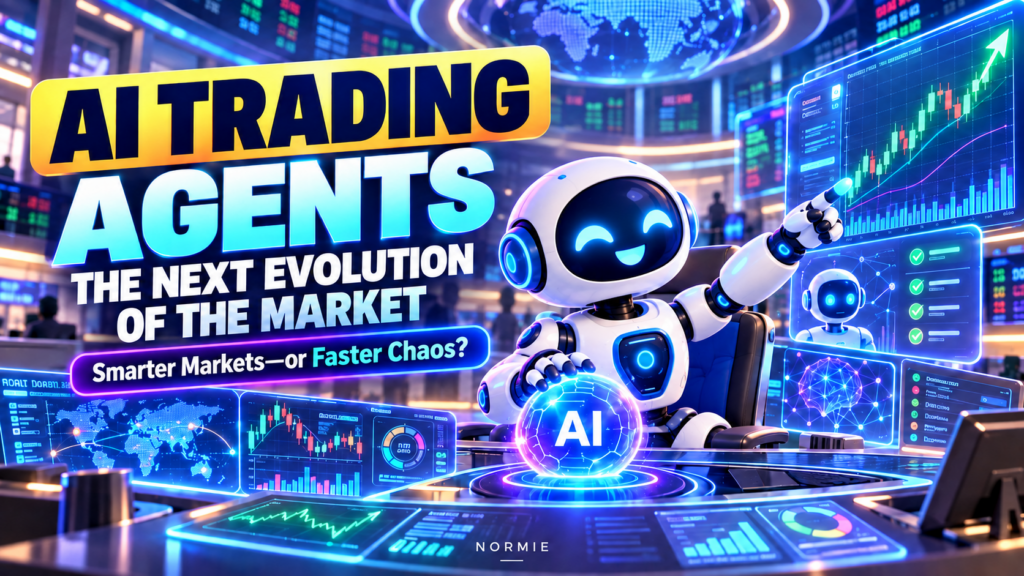
AI Trading Agents: The Next Evolution of the Market
Artificial intelligence is quickly moving beyond market analysis and into autonomous decision-making. The next generation of trading agents will continuously research markets, evaluate opportunities, manage risk and execute trades—often faster than any human could respond.
The shift is already visible in intellectual property. AI-related content appeared in more than 50% of algorithmic-trading patent applications each year from 2020 onward, compared with only 19% in 2017. The race to build smarter trading systems is clearly accelerating.
Early research also suggests that AI agents may be capable of identifying meaningful opportunities. One 2026 experiment used an autonomous agent to analyze Russell 1000 companies and reported an annualized Sharpe ratio of 2.43 from buying its 20 highest-ranked stocks. The performance was concentrated among the agent’s strongest selections, however, and should not be interpreted as proof that AI can consistently beat live markets.
The commercial opportunity is becoming difficult to ignore. The broader AI-agents-in-financial-services market is projected to grow from approximately $691 million in 2025 to $6.7 billion by 2033, representing annual growth of about 31.5%. That forecast includes more than trading, but autonomous research, portfolio monitoring, risk analysis and trade execution could become important parts of this expanding market.
The biggest question may not be whether AI agents will trade. It may be what happens when millions of agents analyze the same information, discover similar signals and attempt to act simultaneously.
Will AI make markets smarter—or simply make their biggest moves happen faster?
Join the conversation at Normie. Vote in the polls, challenge the crowd, share your perspective and discover whether your market outlook matches the majority—or makes you the outlier.
Visit Normie at https://normie.one/